
I was led blindfolded into a rope maze in the woods. The path looped around in a complex zigzag. As I gripped the rope, I occasionally heard a classmate yell, “What is the answer?” “I feel like I am walking in circles!” or even “Can’t you just let me out?” The key words to be released from the maze were: “May I please have some help?”
Asking for help doesn’t seem hard, but in an unfamiliar place with unfamiliar people, it can be daunting. In that moment, I realized I was more comfortable pretending I knew where I was going than admitting I needed help.
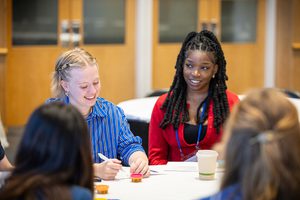
This was just one of the lessons I learned as a Hillary Rodham Clinton Center (HRCC) Fellow in the program’s summer Anchor Point Civic Action Lab, which centered on activities that taught me to step outside my comfort zone and understand what it means to be part of a community, and showed me not just how I could contribute to the world around me in a positive way, but how I could lead within it.
Each year, a cohort of around 150 Wellesley sophomores becomes Clinton Fellows. Our first intensive is the summer civic action lab, which we began in small groups named for notable Wellesley alums. Mine honored Ophelia Dahl DS ’94, a civic innovator and activist for health care and social justice. The group quickly became my home base for the many workshops we went through. It was a smaller community where I asked questions and formed the connections that defined this experience.
HRCC program director Heidi Johnson kept us moving throughout the three-day intensive. We completed the ropes course and trust exercises on Cathleen Stone Island in the Boston Harbor, heard from civic innovators at an Artists for Humanity exhibit, listened to American Railroad with the Silkroad Ensemble, and had many other meaningful experiences that offered lessons about service and leadership and challenged how I show up for a community. A few moments in particular reshaped my understanding of what it means to make a difference.

Cuerd@s, founded by Megan Burke, puts into practice what we spent time learning: Service can begin with a simple idea and grow into meaningful support. Burke started her business in college with a plan to make a self-soother, hand-sewn into any item of clothing and easy to fidget with in moments of discomfort, that could provide comfort for her sibling. Her work showed me that vulnerability can be a starting point for helping others. We cannot sustain care for our communities while pretending we never struggle ourselves.
I learned another valuable lesson when we were thrust into a Senate simulation at the John F. Kennedy Presidential Library and Museum. Here our goal was to draft and sign a highly relevant new bill proposal on artificial intelligence regulation. I entered assuming that, using tools for constructive dialogue, we would reach a sensible compromise. This became difficult when we had to represent people who were relying on us to act in their best interests. I took away that the core of being a senator is engaging with constituents and making informed decisions on their behalf. I expected compromise to feel noble and clear. Instead, it felt frustrating and slow, which made the lesson even more real.
Our civic action lab service was not only about reflection and discussion, but about showing up and working together. We spent one morning packaging food for End Hunger New England, which distributes meals to communities across the region. As we worked like a well-oiled machine, the lessons from the previous days began to feel more concrete. Everything becomes part of something larger in that sense; alongside everyone else’s effort, we take responsibility.
-

Clinton Fellows participated in a senate simulation at the John F. Kennedy Presidential Library and Museum. -

One morning was spent packaging food for End Hunger New England, which distributes meals to communities across the region.
Our work will continue through the fall, winter, and spring, but the retreat ended just before fall classes began. We marked the moment by hanging woven patches in the academic quad, each signifying something we hoped to accomplish before leaving Wellesley. As a political science and philosophy double major, I am always learning the tools, references, and theories that shape these intricate relationships. The lab helped me see how to put that knowledge into practice. Being a Clinton Fellow means that, for life, I will value all that those around me bring to the table and how I can make a difference just by sitting at it.
I have always wondered what it really means to make a difference in the world and lead a life that benefits others. Even before college, I wanted to help create a better world and foster kindness, but that ambition felt vague. That desire drew me to Wellesley, where civic engagement and leadership extend beyond the classroom and into the world, and to the Clinton Fellows program, which perfectly aligned with the values I was hoping to find. I wanted to understand what service looks like when it is not just an idea in a brochure, but a choice made in a meeting, a meal, a classroom, or a shared community space. After this summer’s Anchor Point Civic Action Lab, I feel much closer to understanding how to be the change I want to see in the world.
Ellie Walsh ’29 is a student writer for the Office of Communications and Public Affairs
