
Wellesley’s Business, Entrepreneurship, and Money Management initiative, better known as BEAM, marked a milestone on November 15 with its inaugural Wellesley in Business Symposium — a gathering designed in partnership with the Wellesley Business Leadership Council (BLC) — to empower future business leaders. BEAM was launched in 2024 with the support of Lois D. Juliber ’71, and the symposium featured a keynote discussion, alumnae panels, and mentorship sessions as well as the final round of the student case competition, a multiday event that allowed students to take a deep dive into a leading global company.
In the opening keynote session, “When Leadership Matters Most—Shaping the Future in Turbulent Times,” Wellesley President Paula A. Johnson and Jean Hynes ’91, CEO and managing partner at Wellington Management, discussed the rapidly shifting global landscape of business, emphasizing its growing globalization and democratization. Hynes drew an analogy between business and education, reflecting that students become the “product” of their education, shaped by their choices and time investments, and those factors can have an impact on their futures.
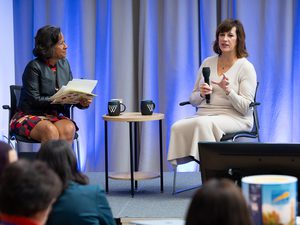
Hynes also offered meaningful advice for students as they move into their careers: Always be learning, create a life where you are well, and figure out what motivates you and others around you. “The more skills you learn, the more you’re able to navigate through difficult times,” she added. Her emphasis on self-awareness and curiosity set the tone for a day of purposeful learning and leadership.
After the keynote, BEAM organizers introduced the new BEAM In-Residence Program, designed to strengthen connections between students and alumnae leaders through mentorship, office hours, and hands-on guidance. The alums being honored in the inaugural 2025–2026 program are executive-in-residence Suzanne Frey ’93, vice president, engineering and product, Google; entrepreneur-in-residence Vicky Tsai ’00, founder of Tatcha; and rising star-in-residence Christine Keung ’14, general partner, J2 Ventures. The three alums, who represent the breadth of Wellesley’s impact across business and innovation, will serve as recurring mentors for students as the program grows.

The morning continued with an alum panel, “Leading Through Turbulence—Stories from the Field,” moderated by Lakshmi Ramarajan ’98, Diane Doerge Wilson Professor of Business Administration at Harvard Business School. Panelists included Joanne Lager ’93, chief medical officer, Genetix Biotherapeutics; Mia Mends ’97, CEO, C&W Services; and Kaitlyn Wilkins ’03, vice president, Small Business Group, Meta.
Drawing from careers that span biotech, facilities management, and tech, they discussed navigating uncertainty, building resilient teams, and managing personal values amid high-stakes decisions. As Wilkins put it, “You are either a thermometer, or you’re a thermostat.” Leaders who are thermometers just react to the room around them, she explained, but thermostats set the temperature: “You set that temperature, you’re building confidence in yourself for your team. No matter the day and what’s going on, [they see] they have a leader in something they can follow.”
Over lunch, students spoke with alumnae mentors. These conversations carried into the afternoon’s case competition finals. The competition had begun the day before, with 18 groups who each were paired with one or two Wellesley in Business mentors. Priya Paul ’88, chairperson of Apeejay Surrendra Park Hotels, and her team had challenged students to create a business strategy for revitalizing the iconic Indian brand for the current market, with an eye toward attracting the Gen Z demographic. Three teams advanced to the finals—Groups 12, 7, and 13—and presented their proposals to the entire audience at the symposium. Ultimately Group 12—Julia Kuang ’26, Lily Deutscher ’27, Ella Kim ’26, and Janine Shivdasani ’26, and mentored by Marilyn Smith ’70—was declared the winner. Reflecting on the symposium, the winning group members said they felt it had been empowering to be in a room full of such well-established and prestigious Wellesley alums. Kuang said she hopes to “become someone that passes their knowledge down as well, making that cycle happen.”

Juliber closed the symposium with reflections on the vision behind BEAM. She emphasized the importance of financial literacy as a life skill.
“Every student should be able to function financially on their own when they graduate,” she said, reminding attendees that BEAM is ultimately about access to knowledge, opportunity, and networks that encourage professional growth.
The afternoon wrapped up with a reception and networking hour, where students lingered to swap LinkedIn profiles and talk with members of the Wellesley Business Leadership Council. The event was both informative, with practical career advice, and personal, with the shared stories from the women who were once Wellesley students themselves. The Wellesley in Business Symposium illustrated what business education can look like at a liberal arts college.