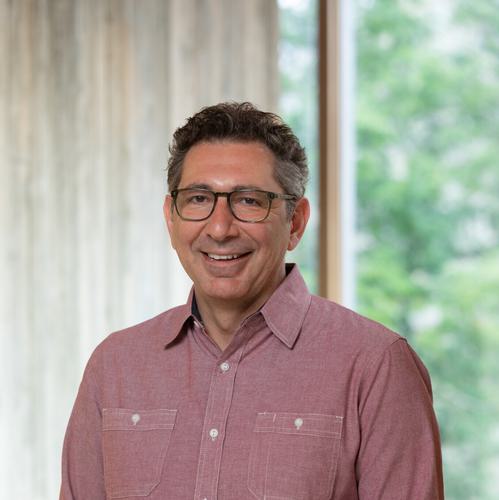
Ismar Volić
Professor of Mathematics
Links
Research in algebraic topology and social choice theory.
Ismar Volić is a Professor of Mathematics and the Director of the Institute for Mathematics and Democracy at Wellesley College. He received a B.A. from Boston University and a Ph.D. in mathematics from Brown University. His research is in topology and social choice theory. He is the author of many articles and books and has delivered more than three hundred lectures in over twenty countries. He was a visiting professor at Harvard University, MIT, and the University of Virginia. His research has been supported by the National Science Foundation, Simons Foundation, and the Fulbright Fellowship among others.
Volić likes to teach across the math curriculum, advise student research, and advocate for mathematics as a relevant and vibrant discipline. He has in recent years dedicated himself to research, education, and outreach on topics that lie in the intersection of mathematics and democracy. It is in this spirit that he co-founded the Institute for Mathematics and Democracy in 2019. His latest book, Making Democracy Count: How Mathematics Improves Voting, Electoral Maps, and Representation, won the Mathematical Association of America’s Euler Prize and was a finalist for the PROSE award given by the Association of American Publishers. The book is based on The Mathematics of Democracy, a popular course he created and has taught for several years at Wellesley.
Volić was born in Sarajevo, Bosnia-Herzegovina and came to the U.S. in 1991 to attend his senior year of high school. Soon after his arrival, a war broke out in his country and he has lived in the U.S. ever since. He now travels to Bosnia-Herzegovina frequently through his involvement in various education and research activities, including advising Ph.D. students and working with various agencies to bring quality STEM education to the country.
Education
- B.A., Boston University
- M.A., Brown University
- Ph.D., Brown University
Current and upcoming courses
Abstract Algebra
MATH305
In this course, students examine the structural similarities between familiar mathematical objects such as number systems, matrix sets, function spaces, general vector spaces, and mod n arithmetic. Topics include groups, rings, fields, homomorphisms, normal subgroups, quotient spaces, isomorphism theorems, divisibility, and factorization. Many concepts generalize number theoretic notions such as Fermat's little theorem and the Euclidean algorithm. Optional subjects include group actions and applications to combinatorics.
-
The Mathematics of Democracy
MATH123
How can a candidate in a political race win the majority of votes yet lose the election? How can two competing candidates interpret the same statistic as being in their favor? How can the geometry of the voting district disenfranchise entire groups of voters? Can we quantify the power the President of the United States has? In this course, we will look at the mathematics behind these and related questions that arise in politics. We will study topics such as fairness, voting paradoxes, social choice, game theory, apportionment, gerrymandering, and data interpretation. The goal of the class will be to illustrate the importance of rigorous reasoning in various social and political processes while providing an introduction to some fascinating mathematics. (MATH 123 and PEAC 123 are cross-listed courses.)