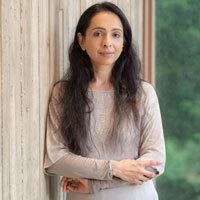
Gurminder Bhogal
Catherine Mills Davis Professor of Music
Scholarly interests focus on the music of French composers including Maurice Ravel, Claude Debussy, Erik Satie, Gabriel Fauré, Maurice Delage; the practice of ornament in French music and the visual arts during the early twentieth century; music and aesthetics; music and orientalism/exoticism/colonialism-decolonialism; Sikh devotional music (Sikh Kirtan); and Sikh art.
My research falls into two areas. The first deals with early twentieth-century French music and culture with a focus on relationships between music and the visual arts. These connections have been explored most recently in Claude Debussy’s Clair de Lune (New York: Oxford University Press, 2018). Other publications that examine the practice and aesthetics of ornament in music composition and visual art of early twentieth-century Paris include Details of Consequence: Ornament, Music, and Art in Paris (AMS Studies in Music) (New York: Oxford University Press, 2013); “Orchestral Tissue, Subordinate Arabesques, and Turning Inward in Maurice Ravel's Boléro,” Music Theory Online 26/2, 2020; and “Ephemeral Arabesque Timbres and the Exotic Feminine,” in Arabesque Without End: Across Music and the Arts, ed. Anne Leonard (New York: Routledge, 2021). Other recent publications deal with Debussy’s piano music; Debussy’s music in video games; and grotesquerie and the oriental subject in The Rite of Spring.
My second research area is on Sikh devotional music. I won the Pauline Alderman Award for Outstanding Scholarship on Women in Music (2017) for my article, “Listening to Female Voices in Sikh Kirtan,” Sikh Formations Religion, Culture, Theory 13/1-2 (2017): 48-77. A recent article about the halo in Sikh art and its connections to divine sound can be read here: "Anahad Naad and Pictorial Resonance: The Halo and Sonic Vibration in Sikh Art," Sikh Research Journal, Spring 2023. I won the Roland Jackson Award in Music Analysis from the American Musicological Society (2025) for a recent article that explores the history of the harmonium in Punjab with a focus on Sikh kirtan: "Tracking the Harmonium from Christian Missionary Hymns to Sikh Kirtan," Yale Journal of Music and Religion 8/2 (2022).
I have recently completed a monograph called Sikh Kirtan and Its Journeys: Instruments, Theories, Technologies (Chicago: University of Chicago Press, 2025). The book is available in print: https://press.uchicago.edu/ucp/books/book/chicago/S/bo257660418.html (30% discount UCPNEW). Open access is available here: https://bibliopen.org/9780226845944. The accompanying website is here: https://sikhkirtananditsjourneys.wordpress.com.
From March 2019 to June 2022, I served as Review Editor for the Journal of the American Musicological Society. I am currently series editor for the American Musicological Society's Studies in Music Series.
I teach a variety of courses in music history, theory, and analysis, some of which have received funding from the Mellon Foundation. Core courses for the music major and minor that I teach include The Symphony in the World (MUS 201); Looking Backwards, Reaching Forwards: Modernism and Music (MUS 202); Expressing Race and Gender through New Music (MUS 202); Opera: Its History, Music, and Drama (MUS 230). My electives focus on a range of topics: The Femme and Her Song; Being Modern in Paris; Virtuosity, Suspicion, Transcendence; Finding France in French Piano Music; Nothingness in Music, Poetry, and Art; Music and Sound in Video Games; Paris Chic: French Music and the Arts; Sacred Sounds of South Asia, Healing Minds and Bodies Through Music.
Education
- B.M., Royal College of Music
- M.M., King's College London
- Ph.D., University of Chicago
Current and upcoming courses
Topics in Music History III Tpc: Race & Gender thru New Music
MUS202
Topic for Fall 2026: Expressing Race and Gender through New Music
This course takes its spark from recent global and on-campus conversations around race and anti-racism in relation to the arts, particularly music composed and created during the twentieth and twenty-first centuries. Students will become familiar with “canonical works” by (predominantly male, some female, and mostly white Euro-American) composers. However, the primary focus is on the creative achievements of under-represented composers and musicians identifying as Black, Latinx, East Asian, and Native American. This course inverts the balance by privileging the artistic accomplishments of composers and musicians who usually reside at the margins of “central” conversations. Our goal is to understand what the traditional category of “modernism and music” reveals about history and society from typically less represented cultural/racial/gendered perspectives. Students will undertake critical listening/viewing/reading assignments and reflect on live performances through writing.
-
Opera: Its History, Music, and Drama
MUS230
This course offers a comprehensive chronological survey of the history and evolution of opera, from 1600 to the present. Lectures will examine historical background, the subgenres of operatic literature (opera seria, opera buffa, music drama), and complete operas by major composers representing a number of periods and styles (including Monteverdi, Mozart, Verdi, and Berg). We will also study librettos, relevant novels, and other source materials in order to establish connections between musical structure and dramatic expression. Two class meetings, with additional sessions required for viewing operas in their entirety.